Saturday, April 24, 2010

OVCs and Trust Community School


When I arrived in Zambia, I knew that I would encounter some commonly used abbreviations, like NGO for Non-Governmental Organization and the local MEF for Mindolo Ecumenical Foundation. But OVC was new to me. MEF offers courses in working with OVCs. Turns out it is the abbreviation for Orphans and Vulnerable Children. And there are far too many in Zambia! The life expectancy here is listed by most sources as 38, although I did find one study that reported a figure of 46. People die young from malaria, AIDS, pneumonia, and other illnesses made more deadly by the weakness of malnourished people.

The plight of OVCs is not just that they live in extreme poverty, often in crowded conditions with extended family and sometimes on the streets. Many of them are not in school. At all. School here costs money. Government schools charge fees ($50-$150 tuition, plus exam fees of $35 or more) and require uniforms. Private schools do, too. I have seen a report that said 40% of all school age children are either not in school or attend erratically because of lack of money for fees. There are no public libraries, few parks or playgrounds (actually, I've seen none), and so I wonder what these children do. In town, some of the street kids are sniffing petrol and showing the effects of brain damage.

So visiting Trust Community OVC School was a breath of fresh air. Besides public and private schools, in some places people have organized at the local level to create a community school which is available free. Trust Community School (TCS) is located in the Chimwemwe-Recourse area, about 10 minutes away from MEF by car. The people of the community, inspired by a retired teacher, got together and decided to start a school in 2005. A land owner gave permission for them to use some vacant land, at least for awhile. They built two rough wooden buildings housing two classrooms each, plus an office and an outdoor class meeting area. A curtain divides the classes, and light filters in through spaces between the boards and from the open area between the top of the wall and the supports for the roof. I hope to have some pictures to post in the near future.

Children sit on benches. The older ones have composition books and pens or pencils, the younger ones draw letters in the dirt with sticks. The teachers use blackboards and a few hand-made teaching aids. There is a map of Zambia painted on one of the outdoor walls. The children are quiet and attentive. When resources are available, TCS has a feeding program to provide a bowl of porridge when the children arrive, since many of them are hungry and they learn better with food in their bellies. But when resources are scarce, they cannot feed the students.

There are 5 teachers and the school holds two sessions a day, serving 350 children. Three of the teachers are government certified, two are teachers in training. They could be considered volunteers, since they are only paid the equivalent of $35 a month. I didn't think to ask, but I imagine that some of them are paid a bit by families for extra lessons or tutoring, and there is surely another income in their households.

The school teaches children grades K-7. It also serves as a community center for HIV/AIDS education and adult literacy classes. Their mission and vision statements speak of educating OVCs and also of reducing illiteracy and providing survival skills and promoting self-reliance among widows, widowers, those living with HIV/AIDS, and "over-aged" school leavers.

The land owner has notified the school of his intention to try to sell the plot where the school is located. The principal, supporters and community leaders were aware that this might happen, so they have spent a good deal of time and energy working with the local government to secure recognition as a charity and to request a plot of land from the community. After many trips to the City Council and much paperwork, they have been given a plot large enough for an expanded school and a farm which can be income generating as well as teaching sustainable agriculture concepts to the children and families. (Most people here grow some food, if they have any little bit of land.)

Of course, the challenge is securing resources. They work with what they have in a way which exemplifies "asset based community development" (all my former students, take note!). But they must receive some help from donors to be able to survive even now, and more to build a quality structure on their new land. Once their income generating projects are set up, they think they can become self-sustaining, but that is quite far in the future. They envision selling produce from the farm, raising chickens, and setting up a carpentry shop.

For now, every day they teach the children that they have in the facility the community built. Some of the older students took the national exam required at the end of 7th grade last fall, and passed. TCS has managed to find sponsors to pay school fees so they can continue on to secondary school. An architect has drawn detailed plans for the new school.

I'm inspired by the spirit and the dedication represented by all the people who make Trust Community School possible. While the ideal solution for Zambia is developing a system of quality free public education, in the meantime, a school like TCS is making a difference for one group of OVCs.

Saturday, April 17, 2010

Malaria Dreams

Malaria is endemic in Zambia. It is the leading cause of death in children under 5. It is also a major contributor to the deaths of persons with compromised immune systems from HIV/AIDS or severe malnutrition. The most dangerous kind is called "cerebral malaria," characterized by fever, headache, confused thinking, flu-like aches and pains, and disorientation. Untreated, it can kill even a previously healthy person.

Every Sunday, I take anti-malaria medication. It is called Mefloquine Hydrochloride, the generic form of Lariam. Two warnings are printed on the container: "May cause dizziness," and "Call your doctor immediately if you experience mood changes, such as new or worsening feelings of sadness, depression, or fear." Luckily, I only felt dizzy after the first time I took the pill, and then only briefly. I have not experienced mood changes. So far, anyway...

Instead, my reaction is what I call "malaria dreams." Additional potential side effects are listed on the enclosure that comes with the pills, and one of them is nightmares. I don't have nightmares, but I do have colorful, bizarre and memorable dreams. People from my past materialize, speak, even dance in and out. Sometimes I am floating, other times I am watching. There are houses with many rooms, open and locked doors, roads cloaked in mists and paths bathed in golden light. I remember fragments. Sometimes I wake up speaking out loud to a character in my dream.

Here at MEF, we all sleep under mosquito nets. The buildings and grounds are sprayed quarterly. And still people get malaria. Caroline (my hostess last week) stopped by today on her way back from a clinic where she had taken her baby for treatment after he was diagnosed with malaria. They do not have mosquito nets at her home. I recall hearing that the Bill and Melinda Gates Foundation was working on the eradication of malaria and was providing mosquito nets in countries with high rates of malaria. The MEF nurse, Margaret, says that she has been notified by the government health ministry that mosquito nets will be coming from America. I pray that they will come to Zambia soon!

Friday, April 9, 2010

Hospitality failure: I couldn't eat the caterpillars

Back in my Peace Corps days, I vowed to eat anything offered in home hospitality. This seemed especially important when the invitation was from a family with limited resources who had prepared food especially for the guests. I have eaten some interesting things under that rule: guinea pig in Peru (yes, tastes like chicken), a hundred year egg in a Chinese home (blackish-greenish in color, kind of salty), "old ham" and beaten biscuit in Kentucky (dry as dust and hard as rocks), roasted goat (tough but good) and millet drink (bitter) in Uganda, but I had never before been faced with a bowl of roasted worms. If the food has a strong flavor, eating it while holding your breath so you don't smell it helps a lot. But these roasted caterpillars looked like caterpillars, had no odor, and the crispy-chewy texture--and then idea of eating a worm--was what I couldn't handle. I did manage to get half of one down, surrounded by nshima, the cornmeal mush that is a staple here, but that was my limit. Fortunately, I had only put two on my plate.

This happened in Caroline's home. She is a big-hearted Zambian woman I met recently who takes in orphans. She asked if I had visited in a Zambian home yet, and when I said I hadn't, she said she would invite me to her house. I don't teach on Fridays, so today she came by to take me for a visit.

She came with the baby tied around her back in a colorful cloth sling. We walked out of the compound, down the road, onto a dirt path through a market, down more dirt roads, to another market where she bought some local eggplants, onions, and the caterpillars. Mountains of caterpillars. She smiled and asked if I liked them. I confessed that I had never eaten one, it was not a food we ate in my country, but I would try them. We walked some more.

When we had walked about an hour, we reached a main road. She asked if I wanted to take a collective taxi the rest of the way, or keep walking. The sun was hot, so I opted for the collective taxi, and we squeezed in with 2 others in the back seat and bounced along for at least 15 minutes more on rutted roads. That was the best dollar I ever spent! When we got out, we still had a ten-minute walk to Caroline's home through wide dirt roads with houses close together, neatly swept yards, many trees.

Crispin, her husband, is a taxi driver. They have 3 children of their own, ages 1, 4, and 7. Caroline farms, cares for her children and the orphans, and is looking for other income generating projects. They feed, clothe, educate and support 12 orphans, none related to their family, in their rented 2-room home. You read it right, two rooms! Here's how it works.

One room is the multi-purpose sitting-room, semi-kitchen, and sleeping room and the other is the bedroom and clothes storage area. There is a wooden front door, but the two rooms are separated only by a curtained doorway. In the all-purpose room, there is a small refrigerator, two sofas and a stuffed chair, a TV (the only luxury), a low coffee table, rolled up grass mats, and in the corner a huge plastic tub filled with all the clean dishes and pots and pans. Cooking is done in the front yard, over a charcoal fire. Clothes are also washed there and hung behind the house on a line to dry. The youngest orphans sleep with the family in the bedroom, the others bed down on the floor and couches in the all-purpose room at night.

Some of us ate in the all-purpose room, others in the yard on mats. Most people eat with their hands in Zambia, just as they did in Uganda. We were given a bowl of water and soap to wash our hands before eating. There is no running water in the home. A latrine is out back.

The orphans range in age from 2 to 16. All but the youngest are in school, which means that this family pays most of its salary for school fees. (Public education is not free in Zambia. School fees run between $50-$125 per child per year, depending on school and grade level.) Much of what they eat grows on the family's small farm plot, a short diatance away. Our meal was nshima, the staple food here, a firm ball of cornmeal mush, together with sweet potato greens cooked with onions, and the roasted caterpillars, which the rest of the family ate happily. I hope they are a good source of protein. We drank chilled boiled water.

Caroline says that she was helped by others when she was growing up, so that is why she takes in the orphans. The older ones try to find part-time work in addition to school to supplement the family income, and they somehow get by. Caroline shows me pictures of some of the people who help her with money when they can because they know that she struggles to find the resources to care for all of them. She lives by faith, and God has never let her down. It is a family full of love.

What an eye-opening and amazing first experience with home hospitality in Zambia!

Saturday, April 3, 2010

On Teaching without Textbooks

When I first arrived at MEF, I met my neighbor, Jenny, a mental health social worker from England. She is teaching the counseling methods course, and is the only other non-Zambian faculty in the program. I asked her about teaching materials and methods. She explained that Zambian students are expected to learn from the lecturer. They will copy down everything the instructor says in their composition books. She said she had prepared a set of handouts for her students when she was back home.

Textbooks are simply not available, and if they were, they would be beyond the resources of the students. The average laborer earns about $100 a month. I don't know what professionals earn, but our students mostly live in dormitories. No one has a car or even a bicycle. They walk everywhere, or take a minibus from the highway. No student has a personal computer or laptop. A few have cell phones. In this program, students receive a diploma, and the level is roughly equivalent to our community college AA degree. The accrediting body is the Technical Education, Vocational, and Entrepreneurial Training Authority within the Ministry of Education.

I was given my teaching assignments by Mrs. Kamiji Malichi, coordinator aof the social work program. She asked me to teach a one-week intensive module on community social work, and then to teach the full semester psychology (human behavior in the social environment) class this semester. She gave me a 3-page outline of the content to be covered in the HBSE course, and one page for the community module. The outlines came from a standardized curriculum manual issued by the government. I asked about resource materials for the instructor. She searched among a set of books in the social work office and came up with a psycholgy textbook from Great Britain, published in 2000. She also gave me a supply of chalk and a dry erase marker. I had told her that I brought several community practice texts with me.

Well, I thought, I'll visit the library and explore what's available there. And, of course, there is the Internet. The library is an appropriate size for the size of the studentbody, but most of the reference and resource books are long out of date. (Possibly discards from some university cleaning out their shelves, or the gift of a 1980's donor.) I found the American Corner, a mini-library set up by our government. It is designed mainly as a resource for students seeking information about the U.S., especially our educational institutions and opportunities. There I found a recent sociology textbook in their collection of materials.

The Internet has been my salvation for supplemental lecture preparation materials when I can access it, but that is the problem. I have a mobile Internet device that plugs into a port on my computer (and on which I load airtime several times a week). It is great for my gmail account, but the strength of the connection is inadequate to allow me to open many web sites, especially during the week. So my daughter Cathy has been finding resources for me and pasting them into emails. It works!

The students are attentive and respectful. In the beginning, they would rise when I entered the classroom and wouldn't leave until I left. Students who were tardy to class would knock timidly and ask permission to join the class late. We set up new class expectations, including that they were to let me know when they did not understand or when what I said didn't seem to fit with or make sense in their culture. It has taken awhile, but we now have more class participation and even debates over some issue, such as the wisdom of corporal punishment as a form of discipline. It is commonly used in the K-12 schools here, where class size may be 50 or more students, but even within my class the students disagreed about its effectiveness and impact. (I had been teaching about social learning.)

Teaching without textbooks has challenged my creativity. I have developed handouts, but even that is difficult in a campus with only one copy machine and limited supplies of paper and toner. The people are poor in Zambia, and so are the institutions. I have put the students into study groups and discussion circles and have slowed the pace of presenting material to accommodate thorough note-taking. All assignments, even research papers, are neatly hand-written with margins drawn by ruler. (I'm sure that at the university level students can access computers, at least in the capitol, and better libraries...I hope.)

Some of my ASU colleagues learned about the lack of books. They, along with a book publisher, have donated some recent textbooks. I am returning to the U. S. briefly for the birth of a grandchild next month. I'll pick up the books and bring them with me when I return to Zambia to add to the social work resource collection and the library. Many thanks, friends, they will be well used!

Saturday, March 27, 2010

Church Services in Zambia

I have been attending the Mindolo United Church of Zambia, or "Mindolo UCZ" (but here, "z" is pronounced "zed" so it is UCZed.) This would be considered a mainline Protestant church, serving MEF and the surrounding community. The English language service is 8:30-10:15, followed by the service in Bemba from 10:30-noon. Both services are full to overflowing, and the sanctuary holds at least 400 people.

If I had to choose two words to describe worship, they would be spirited and organized. The singing shakes the building. Zambians, who are so soft-spoken in everyday conversation that you have to listen hard to capture what they are saying, sing with Ethel Merman gusto! The amazing part is that they all seem to sing harmony and they know the hymns by heart. (That is fortunate, since there are only a few "Africa Sings" songbooks--with words only--scattered through the pews.) Most of the time we are singing a capella. I recognize many of the hymns as ones my grandmother used to sing--Blessed Assurance, How Great Thou Art, and the like. Songs like "Siya Hamba" (We are Marching to the Light of God) or "I, the Lord of earth and sky..." are too modern for the edition of the songbook they have, although they do sing some lovely praise chants.

We sit on wooden benches with one plank behind our backs, women mostly in traditional African dress or at least skirts or chatangas (the colorful pieces of cloth from which you make a wrapped skirt, ankle length), the men in shirts and ties, or the African man's top decorated with embroidery. When the pastors and deacons come in, everyone rises until they are seated at the front, facing the congregation. Some wear robes, most do not. The choirs don't have robes, either.

After singing and an opening prayer, we have announcements. This is very important, for it is the source of communication about the life of the church. There are no bulletins for the service, no church newsletter--these would require resources and technology not available here. Instead, we learn about events and upcoming activities, births, deaths, and responsibilities through a period of announcements that can take 15 minutes. We learn which church group is scheduled to clean the church the following Saturday. People are thanked for help they have given, and newcomers are welcomed. At first, I couldn't figure out why, periodically, we clapped three times after some announcement or comment. Then I listened for the pattern, and discovered that it happens after the person adds the phrase "in the name of the Father, the Son, and the Holy Spirit," we welcome you or thank you or send our condolences or whatever. So anouncements are punctuated by three claps every so often. No one ever falls asleep in the service!

More singing follows, and then the offering. There is a sort of table with wooden compartments at the front, and row by row, the entire congregation comes forward to deposit their gifts. The geographic area the church draws from is divided into 16 districts, and one's offering is placed in the bin corresponding to their district. Each church member has a personal blue laminated offering envelope which they probably pick up as they are coming into the church, or maybe they get it back after the service. There is a special bin labeled "Visitors" where non-members place their gifts. The choir sings while the offering is brought forward in this orderly procession, and then the choir sings and dances their way to the table to place their envelopes in the proper compartments. One Sunday, when a lot of people, mostly students, had come into the service right after the offering time, the pastor created a second offering time for the latecomers.

More singing, praying, and then the sermon. Since there is a theology school here at MEF, sometimes the sermon is given by a student. Always it is Biblically based, and everyone brings a Bible to the service and follows along with the scripture reading. The style of the sermons is more like an African American church than a white church, but perhaps not quite so emotional in this congregation. There are some "amens" from the congregation from time to time. And when the choir sings, sometimes a congregant will unselfconsciously stand and sing with them, or raise her arms or sway and dance with the music.

Sometimes the choir is accompanied by a keyboard, sometimes they sing a capella. There seem to be two choirs, one a youth group, and the music is always lively and rhythmic, frequently with patterned clapping and finger snapping. Sometimes they sing in Bemba, the local language.

The church building is a simple oblong structure with a copper corrigated roof. There are lace curtains at the windows, lace covers on the altar and lectern, and a blue curtain behind the altar. When we had communion, the curtain was opened to reveal a painting of the Last Supper.

When the service closes with more singing and a benediction, we all stand as the pastors and deacons walk back down the aisle, and then we are guided to leave pew by pew, in an orderly procession. People greet each other outside, especially if we didn't "pass the peace" during the service. Streams of people then walk home, some of them a couple of miles or more. I would say that there are no more than 5 to 7 cars driven to the service. Everyone else came on foot.

I plan to visit a few different churches while I am here. One of my students has invited me to her Pentecostal church, and tomorrow--at 7:30 am!--I am going with a neighboring family to the Bread of Life church (not sure what denomination it is.) Like my experience in Uganda, church is an important institution here and the congregation has a better balance of men and women than you see in most U.S. churches. I find that I miss inclusive language, that change hasn't reached here yet, but I love the strong, vibrant spirit in the worship and the radiant joy of the singing.

Friday, March 19, 2010

Moses and Violet

Moses appeared at my back door two weeks ago, a tool called a slasher in his hand. He asked if he could work for me, cutting the grass and tending my yard. He was thin and looked hungry. We sat and talked. He hasn't been able to send his youngest child to school yet, because he can't afford the fees. He has 3 children, and the youngest is 6. We looked at my yard, which is quite large. He said he could plant a vegetable garden, and put flowers near the front and back doors. I hired him. All Zambians receive training in agriculture if they go to school at all, and he knew just what he wanted to do to create a beautiful yard.
He has come every day for at least part of the day to work. He asked if I would pay him the first week's pay at the end of the week so he could use it to make an installment payment and enroll his child in the government school. After that, however, he wanted to be paid only at the end of the month, so he could be saving money. His mother is a widow living in a little village, and her only support comes from her two surviving children. Her house is falling apart, and he and his brother want to repair it before the next rainy season. Every time he comes, he shows me what he has done and tells me his plans. He has not asked for anything other than his salary, but when I learned that his children were having problems with mosquito bites, I bought mosquito nets for their beds. Such a little thing, but he showed such gratitude.

Violet came to my back door to ask if I needed someone to do my laundry and clean house. Everything must be washed by hand, no washing machines, and also must be ironed to kill bugs that lay eggs in the seams of the clothes as they dry outside. She has completed the teacher training program to be able to teach at the primary level and is awaiting the results of the national exam. Assuming that she passes, she will begin to receive a small monthly stipend from the government and within a year or so they will assign her to a school in a rural area.
Violet's story is all too common. Orphaned, she was passed among the homes of various family members. She was physically abused and maltreated. She stayed in school, but at age 16 married to get out on her own. Everything was all right for a few years, until her husband began to beat her and to go with other women. She decided she would be better off without him, so she took her two boys and left. That was when she came to work for Adrian, the chaplain at MEF. He saw that she was a hard worker and smart, so he asked about her aspirations. When she said she had always hoped to be a teacher, he sponsored her at the MEF teacher training program. She passed her first year exam with merit, quite an accomplishment for a single mother studying, tending her home, working as a maid, and going to classes all at once. She completed the second year, including practice teaching, and now is awaiting her future career. Meanwhile, she cleans for Adrian and me. Her boys are 6 and 9, I believe. She always has a beautiful smile as she greets me on Mondays and Wednesdays.

More people have come to ask if they could work for me. There is such a need for work, and a willingness to work, among people here. I wish I had a better way to respond than to tell them that I'm sorry, I have all the help I can use with Violet and Moses.

Keep us all in your prayers.

Thursday, March 11, 2010

International Women's Day in Zambia


International women's Day, which is sponsored by the United Nations and is observed worldwide, is one of a small number of national holidays in Zambia. It happened Monday, March 8. No school, all public offices and a lot of businesses closed. There was a parade and celebration in Kitwe, with many participants--the YWCA, Girls Brigade, women's service clubs and church groups, women's student groups, professional women's organizations, all with banners and some with uniforms or coordinated colors. A band played, and it was festive and inspiring. Speakers identified areas of concern, including violence against women, HIV/AIDS, lack of representation in the political arena, need for more educational opportunities for girls. They also spoke of women's leadership in community improvement and social services. On the radio, BBC featured many stories about issues affecting women and about women's projects in Africa. (There is a special British Broadcasting Company FM station with an emphasis on news and stories of interest to Africa. It broadcasts 24 hours a day and is my radio station of choice here.)

At MEF, the chaplain asked if the women faculty, staff and students would plan a special observance to commemorate International Women's Day at chapel time scheduled for Tuesday, the day after. When we started thinking about it, I mentioned that there was a Bible story that might be a good one to share in the service, a story about courage and hope that features five sisters (Numbers 27:1-8). As Moses was leading the Israelites out of slavery in Egypt, on their way to the promised land, a long and arduous journey, many people began to grumble and complain. Some of them rebelled. Among the people was a family with five daughters and no sons. The father died. By custom and law, daughters had no inheritance rights. These brave sisters, one of whom was named Noa (my granddaughter's name), went to Moses, Eleazar the priest, and the Assembly and asked for their father's portion, the property he was due among his clan when they settled in the new land. Moses took their case to God, and God instructed Moses to give the sisters property as an inheritance, and to do so for other families where the father dies without a son but with a daughter.
We all agreed that this story certainly fit with the theme of International Women's Day, which was "Women's rights, women's opportunity, progress for all." The students decided to have someone read the scripure and then to enact it in a skit (which they called a sketch). Different students volunteered to play the parts, and they went off to decide how to portray the story. I was asked to offer the reflection, and the choir of girls called "Joyful Noise" said they would choose a couple of songs that went with the theme.
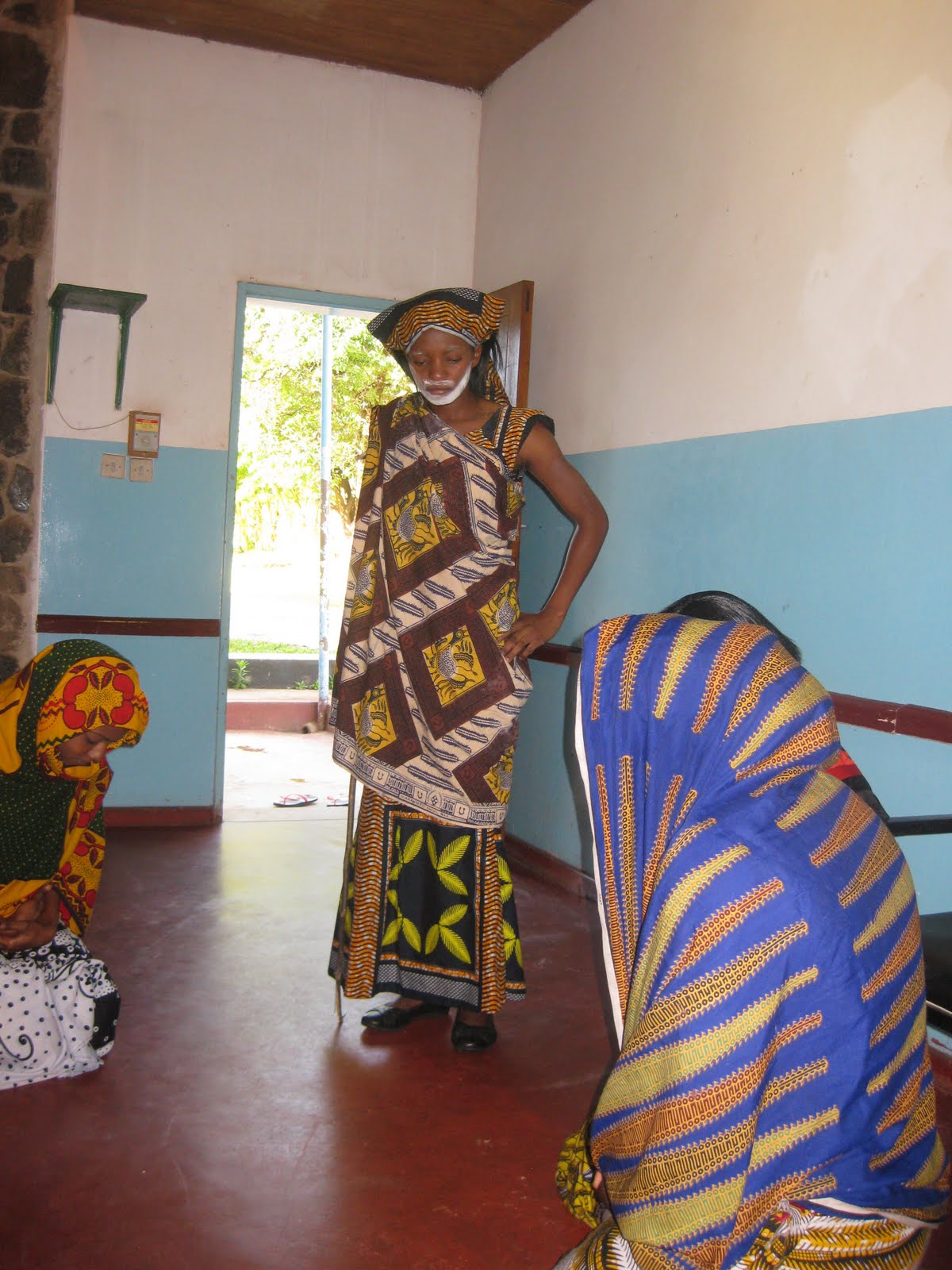
The skit was wonderful, and definitely the highlight of the service. It was an African portrayal that captured the essence of the story dramatically. The sisters wore long traditional African dresses, with shawls to cover their heads signifying mourning. They came in carrying water and burdens on their heads, and swept the floor and talked about the loss of their father. Then they worried about their fate, since they would be left dependent upon uncles or other male relatives. They decided to go before Moses, in a humble way, but with a clear request. Moses was a tall, thin woman student who had used white cream to create the appearance of a beard, had a stick as a staff and walked slightly bent over. Everyone clapped at her creative portrayal. The sisters knelt down before Moses when they made their request (traditional African gesture of respect for great authority). Then Moses knelt before the altar, behind which another student was crouching to be the voice of God. Moses raised his arms and told God what he had been asked to do, and the voice of God pronounced the ruling. Moses went back to the sisters and the assembly, and all cheered and clapped. It really made the story come alive! Then we had the music and the short reflection and more music and that was our final commemoration of the holiday. I taught a class on community social work right afterwards, and we drew on the story to illustrate women's empowerment and how support of numbers working together helps in a change effort.

Someone was taking pictures at the chapel service, at the top of this entry there's a good one of Moses and another one of the five sisters.